

 Technology blogs rely heavily on search engine visibility to attract readers, build credibility, and generate revenue. Whether covering software reviews, cybersecurity trends, artificial intelligence, cloud computing, or consumer gadgets, ranking well in search results is often a key driver of traffic growth.
Among SEO metrics, Domain Authority (DA) and Page Authority (PA) are frequently used to evaluate a website’s ranking potential. While both metrics provide valuable insights, many technology bloggers struggle to determine which one deserves greater attention. Using tools such as DA PA Checker can help bloggers monitor both metrics and better understand how their website and individual pages compare against competitors in search visibility.
Understanding Domain Authority
Several factors influence Domain Authority, including:
- The number of referring domains
- The quality of backlinks
- Link diversity
- Overall website trustworthiness
- The strength of the site’s backlink profile
A large technology publication such as TechCrunch or Wired typically has a high Domain Authority because of its extensive backlink profile and industry recognition.
Understanding Page Authority
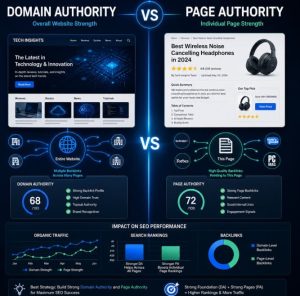
Page Authority focuses on a page’s ranking strength rather than a website’s overall ranking. Like Domain Authority, Page Authority uses a scale from 1 to 100. The metric estimates how well an individual page may perform in search results based on factors such as:
- Backlinks pointing directly to the page.
- Internal links from other pages
- Content relevance
- Link quality
- Overall page strength
For example, a technology blog may have a Domain Authority of 50, while one of its popular product review pages may have a Page Authority of 60 because it has attracted numerous high-quality backlinks. Page Authority provides a more focused view of a page’s ability to compete for specific keywords.
How Domain Authority Benefits Technology Blogs
Technology blogs often publish hundreds or even thousands of articles over time. A strong Domain Authority can provide advantages across the entire website.
Some key benefits include:
Faster Content Indexing
Search engines tend to discover and index new content more quickly on authoritative domains. This can be particularly valuable when covering fast-moving technology topics.
Improved Ranking Potential
When a website has strong domain-level authority, new pages may have a better chance of ranking even before earning their own backlinks.
Greater Trust
A high-authority domain often signals credibility to both search engines and users, helping content compete in crowded search results.
Stronger Internal Link Value
Pages on authoritative websites can pass more ranking strength through internal links, helping newer articles gain visibility.
For technology blogs that publish content consistently, Domain Authority lays a foundation for long-term growth.
How Page Authority Impacts Individual Rankings
While Domain Authority influences a website’s overall strength, Page Authority often has a more direct effect on individual search rankings. Search engines rank pages, not domains. This means every article, review, guide, or tutorial must demonstrate enough relevance and authority to compete for its target keywords. Page Authority becomes particularly important for:
- Product reviews
- Comparison articles
- Buying guides
- Technical tutorials
- Industry research reports
For example, a technology blog may have moderate Domain Authority but still rank highly if a particular page has earned strong backlinks and established authority around a specific topic. In competitive technology niches, individual page strength can often determine whether content reaches the first page of search results.
The Relationship Between DA and PA
Domain Authority and Page Authority are closely connected. A website with strong Domain Authority often finds it easier to build Page Authority because:
- New content benefits from domain-level trust.
- Internal links pass authority to new pages.
- Established brands attract backlinks more easily.
- Search engines already recognize the site’s expertise.
At the same time, strong individual pages can boost Domain Authority by attracting high-quality backlinks to the website. This relationship creates a cycle in which domain strength and page strength reinforce one another. Technology blogs that focus on improving both metrics typically achieve better SEO results than those concentrating on only one.
Domain Authority Matters More for Long-Term Growth
Technology blogs seeking sustainable organic traffic growth should prioritize building Domain Authority.
A strong domain creates advantages across the entire website, including:
- Better visibility for new content
- Increased trust
- Improved crawl efficiency
- Greater competitiveness in search results
As a blog expands, Domain Authority becomes increasingly valuable because it supports every page published on the site.
Page Authority Matters More for Specific Rankings
If the goal is to rank a particular article or product review, Page Authority often has a more immediate impact.
A page with strong backlinks, excellent content, and strategic internal linking may outperform competing pages even when hosted on a website with lower Domain Authority.
How Technology Blogs Can Improve Both
The most effective SEO strategies strengthen both Domain Authority and Page Authority simultaneously.
Create High-Quality Content
Detailed guides, original research, and expert analysis attract backlinks and improve authority at both levels.
Build Relevant Backlinks
Links from technology publications, software companies, and industry websites support domain and page growth.
Use Strategic Internal Linking
Connecting related articles helps distribute authority throughout the website.
Publish Consistently
Regular content creation expands topical coverage and increases opportunities for earning backlinks.
Update Existing Content
Refreshing older articles keeps information accurate and helps maintain rankings over time.
Avoid Focusing Solely on Metrics
While DA and PA are useful indicators, they should not become the primary focus of an SEO strategy.
Technology bloggers should also monitor:
- Organic traffic
- Keyword rankings
- User engagement
- Time on page
- Conversion rates
- Backlink quality
Ultimately, success depends on providing valuable content that satisfies user intent rather than simply increasing authority scores.
Conclusion
Domain Authority and Page Authority both play important roles in the success of technology blogs, but they serve different purposes. Domain Authority reflects the overall strength and credibility of an entire website, while Page Authority measures the ranking potential of individual pages.
For technology blogs focused on long-term growth, Domain Authority provides the foundation needed to compete in increasingly crowded search environments. However, Page Authority often has a more direct influence on the performance of specific articles, reviews, and guides. Rather than choosing one over the other, technology bloggers should work to strengthen both. A website with strong domain-level credibility and authoritative individual pages is better positioned to achieve sustainable search visibility, attract organic traffic, and establish itself as a trusted source within the technology industry.